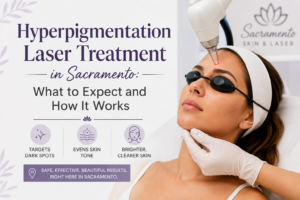
If dark spots, melasma patches, or uneven skin tone have made you feel like no serum is ever quite enough, you are far from alone. Hyperpigmentation is one of the most common concerns we see at a med spa, and one of the most responsive to the right laser approach. Before you book, it helps to understand what hyperpigmentation is, how laser energy targets it, and what your skin needs in the weeks that follow. As with any aesthetic treatment, a consultation with a licensed medical provider is the essential first step.
1. What Is Hyperpigmentation?
Hyperpigmentation describes any area of skin that appears darker than the tissue around it. The darkening happens when melanocytes (the cells responsible for skin pigment) become overactive and deposit excess melanin in concentrated patches. The most common types are melasma (hormonally driven, often across the forehead, cheeks, and upper lip), post-inflammatory hyperpigmentation (dark marks left after acne or injury), and sunspots (caused by cumulative UV damage). Each has a different root cause, but all share the same mechanism: too much melanin in one place. Topical brighteners can manage mild discoloration, but deeper or stubborn pigmentation typically requires a treatment that works beneath the skin’s surface.
2. How Does Laser Energy Target Pigment?
Laser treatment works by delivering precise wavelengths of light into the skin. For hyperpigmentation, the target chromophore is melanin. When melanin absorbs laser energy, it heats and breaks up pigment clusters, which the body then clears gradually through its natural processes. The critical variable is selectivity: the laser must heat melanin precisely without overheating surrounding tissue, which could trigger inflammation and cause new pigmentation, a condition called post-inflammatory hyperpigmentation (PIH). This is exactly where the technology choice matters.
At Organic Skin Studio, the Aerolase system uses 650-microsecond technology to deliver energy in extremely short pulses. The pulse is brief enough that melanin absorbs the light before thermal buildup can spread to adjacent skin, making clearance effective while dramatically reducing the PIH risk that has historically made darker skin tones wary of laser treatments.
3. Is Aerolase Appropriate for All Skin Tones?
Older laser systems with longer pulse durations carry a higher PIH risk for patients with more melanin in their skin, which is why some providers are cautious recommending laser for deeper complexions. Aerolase’s 650-microsecond pulse directly addresses this: energy is delivered so quickly that surrounding skin does not have time to react, making the treatment appropriate for a broader range of Fitzpatrick skin types. A thorough consultation is still essential, as every patient’s skin responds differently, and treatment parameters need to be individualized by someone who understands your history and specific pigmentation type. Vann Luong, PA-C assesses all new patients before their first session to build a safe, personalized plan.
4. What Does a Session Feel Like, and How Many Will You Need?
Most patients are pleasantly surprised by how comfortable Aerolase is. Rather than the rubber-band snap of older systems, the sensation is closer to mild warmth. Sessions for hyperpigmentation take roughly 15 to 20 minutes, with no numbing cream or skin cooling required. Downtime is minimal; some temporary redness for a few hours is common, but most patients return to normal activities the same day.
Results build over a series of treatments. The standard protocol for melasma, sunspots, and post-inflammatory pigmentation is six sessions, spaced to allow the body to clear treated melanin between appointments. Visible improvement typically begins after two to three sessions, with continued progress through the series. Melasma requires particular patience since it is hormonally driven and prone to recurrence with sun exposure or hormonal changes. It responds well to laser, but works best as part of an ongoing management strategy rather than a one-time fix.
5. Aftercare: Protecting Your Results
In the 48 hours after a session, keep your routine simple: gentle cleanser, hydrating moisturizer, and SPF. Avoid exfoliating acids, retinoids, and heat-intensive activities. Beyond those first two days, the single most important thing you can do to protect your results is consistent sun protection. The American Academy of Dermatology identifies UV exposure as the primary trigger for most forms of hyperpigmentation, and the Skin Cancer Foundation recommends daily broad-spectrum SPF 30 or higher, reapplied every two hours during outdoor activity. Skipping sunscreen will undo the work done by your laser treatment and can cause pigmentation to return faster.
Key Takeaways
- Hyperpigmentation forms when melanocytes overproduce melanin, resulting in dark patches from melasma, sun damage, or post-inflammatory responses.
- Aerolase’s 650-microsecond technology targets melanin precisely, reducing the risk of post-inflammatory hyperpigmentation that concerns many patients with deeper skin tones.
- Sessions are 15 to 20 minutes with no downtime (no numbing, no skin cooling, no recovery day needed).
- A series of six sessions is the standard protocol, with visible improvement beginning after two to three treatments.
- Daily SPF 30+ is non-negotiable. UV exposure is the leading trigger for hyperpigmentation and the fastest way to lose your results.
Frequently Asked Questions
Can laser treatment make hyperpigmentation worse?
With the wrong technology or in inexperienced hands, yes. Some systems can trigger PIH, especially in darker skin tones. Aerolase’s ultra-short pulse minimizes this risk, but individualized treatment parameters set by an experienced provider are essential.
How many sessions are needed for melasma?
Most patients see meaningful clearance over a series of six sessions. Melasma is a chronic condition, so maintenance sessions one to two times per year often help sustain results.
Can hyperpigmentation laser treatment be used on the body?
Yes. The neck, chest, shoulders, and hands are all treatable areas, not just the face. Your provider will adjust parameters for the specific area.
How long do results last?
With diligent sun protection, results can be maintained for years. Sun exposure, hormonal shifts, and skin inflammation are the main triggers for recurrence.
Is it safe to combine laser treatment with a chemical peel?
The Aerolase protocol can be combined with peels for faster results. Your provider will advise whether a combined approach is appropriate for your skin at your consultation.
Conclusion
Hyperpigmentation responds to the right laser treatment, and the Aerolase system at Organic Skin Studio offers Sacramento patients one of the most comfortable, low-downtime paths to a clearer, more even complexion. Whether you are dealing with melasma, sunspots, or dark marks from past breakouts, a personalized laser treatment plan can make a meaningful difference.
Book a free consultation with Vann Luong, PA-C to assess your skin and map out next steps. If cost is a consideration, we offer interest-free financing through Cherry so you can get started without the full upfront expense.