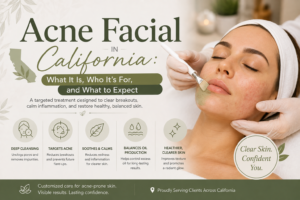
Breakouts do not follow a schedule. Whether you are dealing with persistent congestion, hormonal flare-ups, or post-acne marks that linger long after the breakout clears, finding a treatment that actually helps without making things worse can feel overwhelming.
An acne facial is one of the most effective starting points for California residents who want professional guidance without committing to a lengthy procedure. When performed by a licensed provider, it addresses the root causes of congestion, calms inflammation, and sets the foundation for clearer skin over time.
Here is what you need to know about acne facials in California: how they work, who they are designed for, and what a realistic treatment plan looks like.
1. What Is an Acne Facial?
An acne facial is a modified professional facial specifically designed to address active breakouts, congested pores, and the conditions that make acne worse. Unlike a standard relaxation facial, every product and technique in an acne facial is selected with breakout management in mind.
A typical acne facial includes the following steps:
- Double cleanse: Removes sunscreen, makeup, and surface oils without stripping the skin barrier.
- Enzyme or chemical exfoliation: Beta-hydroxy acids (BHAs) such as salicylic acid penetrate the pore lining to dissolve oil and debris. Unlike physical scrubs, they work inside the pore rather than on the surface.
- Steam: Warm steam softens pore walls and loosens impactions, making the next step more effective and less uncomfortable.
- Manual extractions: A licensed provider carefully clears blackheads and closed comedones (whiteheads) using professional tools and technique. Inflamed, nodular, or cystic lesions are typically left alone to avoid spreading bacteria or scarring.
- High-frequency or LED therapy: Blue LED light or high-frequency current can help reduce bacteria on the skin’s surface and calm post-extraction inflammation. Not every provider includes this step, but it is a common add-on at medical-grade facilities.
- Calming mask: A soothing mask often containing kaolin clay, niacinamide, or zinc reduces redness and absorbs excess sebum.
- Lightweight hydration and SPF: Acne-prone skin still needs moisture. A non-comedogenic serum and moisturizer finish the treatment, followed by broad-spectrum SPF before you step outside.
The entire session typically runs 50 to 75 minutes.
2. How Is an Acne Facial Different from a Regular Facial?
The difference between an acne facial and a classic facial is not just about the products it is about the clinical approach.
In a standard facial, the goal is skin maintenance: cleanse, exfoliate, hydrate, and relax. In an acne facial, the provider is actively working to interrupt the acne cycle. That means choosing exfoliation methods that address pore congestion rather than surface texture, performing more thorough extractions, and avoiding any ingredients — fragrances, heavy oils, or comedogenic emollients that could trigger further breakouts.
At a medical spa, acne facials are also performed under medical oversight, which means your provider can identify when a breakout pattern suggests a need for additional care. The American Academy of Dermatology notes that inflammatory acne, cystic acne, and hormonally driven breakouts often benefit from a combined treatment approach rather than facials alone.
3. Who Is a Good Candidate for an Acne Facial in California?
Acne facials are appropriate for a wide range of skin types and acne presentations, but they work best for people dealing with:
- Comedonal acne: Blackheads and whiteheads that are not yet inflamed. This type of acne responds well to extraction and BHA exfoliation.
- Mild to moderate inflammatory acne: Red, raised papules or pustules that are not deeply cystic. Your provider will work around inflamed lesions rather than attempting to extract them.
- Congested skin: Enlarged pores, rough texture, and persistent dullness often signal trapped sebum and dead skin cell buildup both of which an acne facial directly addresses.
- Post-acne skin maintenance: If your breakouts are mostly controlled but you want help with residual congestion and uneven tone, regular acne facials can maintain that progress.
Acne facials are generally not recommended for people with active cystic or nodular acne, open wounds, or severely compromised skin barriers. A licensed provider can assess your skin at a consultation and advise whether a facial is the right starting point or whether a different treatment protocol is more appropriate.
4. What Results Can You Realistically Expect?
An acne facial is not a one-time fix. Like most professional skin treatments, results are cumulative.
After a single session, most patients notice:
- Reduced surface congestion
- Smoother skin texture from exfoliation
- Mild redness (which typically fades within a few hours)
- A more even, refreshed complexion
After a series of regular treatments typically scheduled every four to six weeks to align with the skin’s natural cell turnover cycle patients often see:
- Fewer active breakouts
- Reduced frequency of congestion between appointments
- Improvement in post-acne marks and uneven tone
- Skin that responds better to at-home acne skincare products
It is worth noting that professional facials work best alongside a consistent at-home routine. Your provider may suggest specific cleansers, BHA exfoliants, or non-comedogenic moisturizers to use between appointments.
5. What to Expect at an Acne Facial Appointment in Sacramento
Before your appointment: Arrive with a clean face if possible. Avoid using retinoids or prescription acids for 48 to 72 hours before your facial, as these can sensitize the skin and make extractions more uncomfortable. Let your provider know about any medications you are taking including oral retinoids or antibiotics since some require adjustments to the treatment plan.
During your appointment: Your provider will begin with a skin analysis, often under magnification, to assess the type and distribution of your breakouts, your pore size, and overall skin condition. From there, every product and technique is tailored to your skin that day not a one-size-fits-all routine.
After your appointment: Avoid heavy makeup immediately after your session. Your skin may show mild redness or faint post-extraction marks, both of which typically resolve within 24 hours. Apply a broad-spectrum SPF 30 or higher before going outdoors — this is non-negotiable, particularly for acne-prone skin that is prone to post-inflammatory hyperpigmentation after any inflammation.
Key Takeaways
- An acne facial is a clinically targeted treatment designed to clear congested pores, reduce surface bacteria, and calm inflammation — not simply a relaxation experience.
- Extractions are performed carefully by a licensed provider inflamed, cystic, or nodular lesions are left alone to prevent spreading bacteria or worsening scarring.
- Results are cumulative: Most patients benefit most from a series of monthly sessions rather than a single appointment.
- Good candidates include people with comedonal, mild-to-moderate inflammatory, or congested skin — your provider will assess at a consultation if a different approach is needed.
- Post-facial SPF is essential, especially for acne-prone skin that is susceptible to post-inflammatory pigmentation after any skin disruption.
Frequently Asked Questions
Can I get an acne facial if I have active breakouts?
Yes, in most cases. A skilled provider will work around inflamed lesions and focus extractions on non-inflamed comedones. However, if you have widespread active cystic acne, your provider may recommend a different treatment approach first. Always disclose your current skin condition at booking.
Will extractions make my acne worse?
When performed by a trained, licensed provider using proper technique, extractions should not worsen acne. Attempting to extract at home increases the risk of pushing bacteria deeper, causing secondary infection, or triggering scarring. Professional extractions are one of the safest ways to clear congestion.
How often should I get an acne facial?
Most providers recommend scheduling every four to six weeks, which aligns with the skin’s natural cell turnover cycle. If your acne is actively flaring, your provider may suggest a closer initial cadence to establish control.
Can an acne facial help with acne scars?
An acne facial targets active congestion and breakout prevention rather than established scar tissue. For post-acne scarring — including atrophic (pitted) scars or significant hyperpigmentation treatments such as microneedling or laser resurfacing are often more effective. Your provider can recommend the right combination based on your specific concerns.
Is an acne facial safe for sensitive skin?
Yes, with adjustments. For sensitive skin types, providers typically use gentler exfoliation concentrations, minimize extraction time, and select calming mask formulations. Disclosing your sensitivity profile at your consultation ensures your treatment is appropriately modified.
Conclusion
Acne facials are one of the most practical tools available for California residents navigating persistent breakouts — whether you are in your teens, dealing with hormonal flare-ups in your 30s, or managing the aftermath of past acne. The key is working with a licensed provider who takes the time to assess your skin rather than applying a generic protocol.
At Organic Skin Studio in Sacramento, our classic facials are customized to your skin’s current condition, with targeted options for acne-prone skin and congestion. Our team, led by Vann Luong, PA-C, will help you understand what your skin actually needs — and build a plan that makes sense for your lifestyle and goals.
Ready to take the first step? Book a complimentary consultation and come in with your questions.